| Part #: | OP041-1V8 |
| Description: | 4-port Gigabit Ethernet FPGA Mezzanine Card with LPC connector and RGMII interface. |
| Vadj: | 1.8V |
| Price: | USD $590.00 |
| HTS: | 8517.62.0090 |
| HS Code: | 8517.62.90 |
| ECCN: | 5A991.b |
| Compliance: | Material Compliance Declaration (PDF, 2026-09-10) |
| EU Declaration of Conformity: | In preparation; see Product compliance |
| Origin: | Canada (CA) |
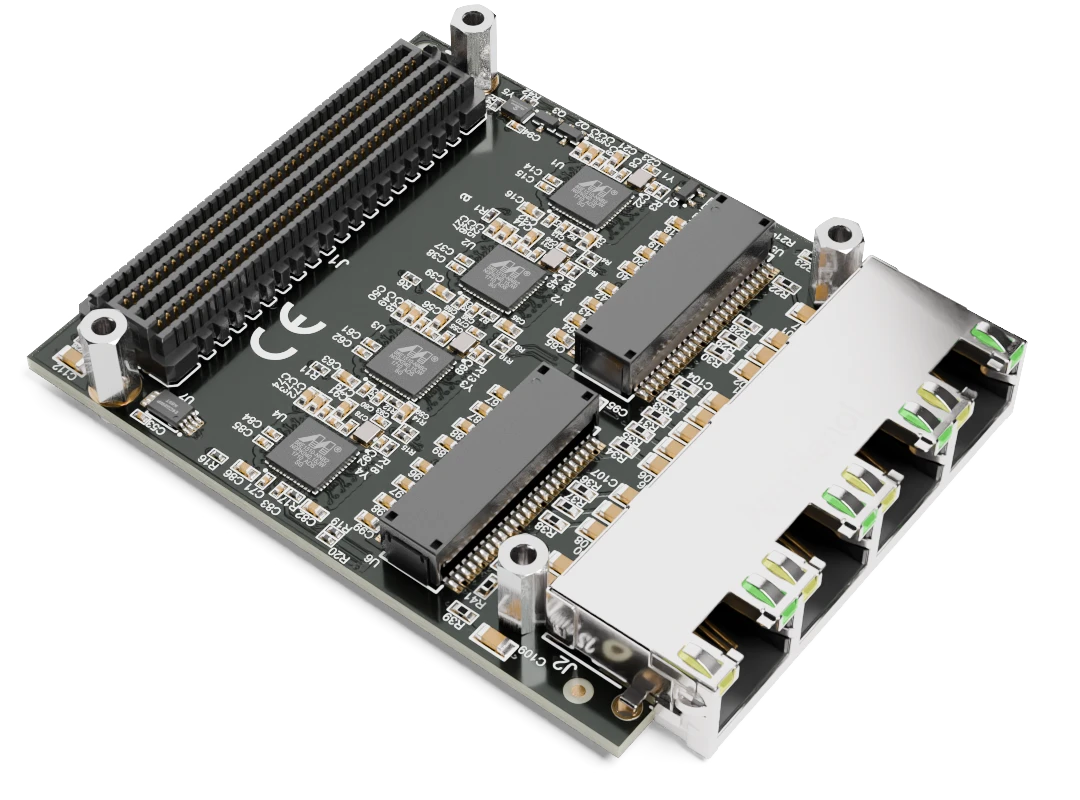
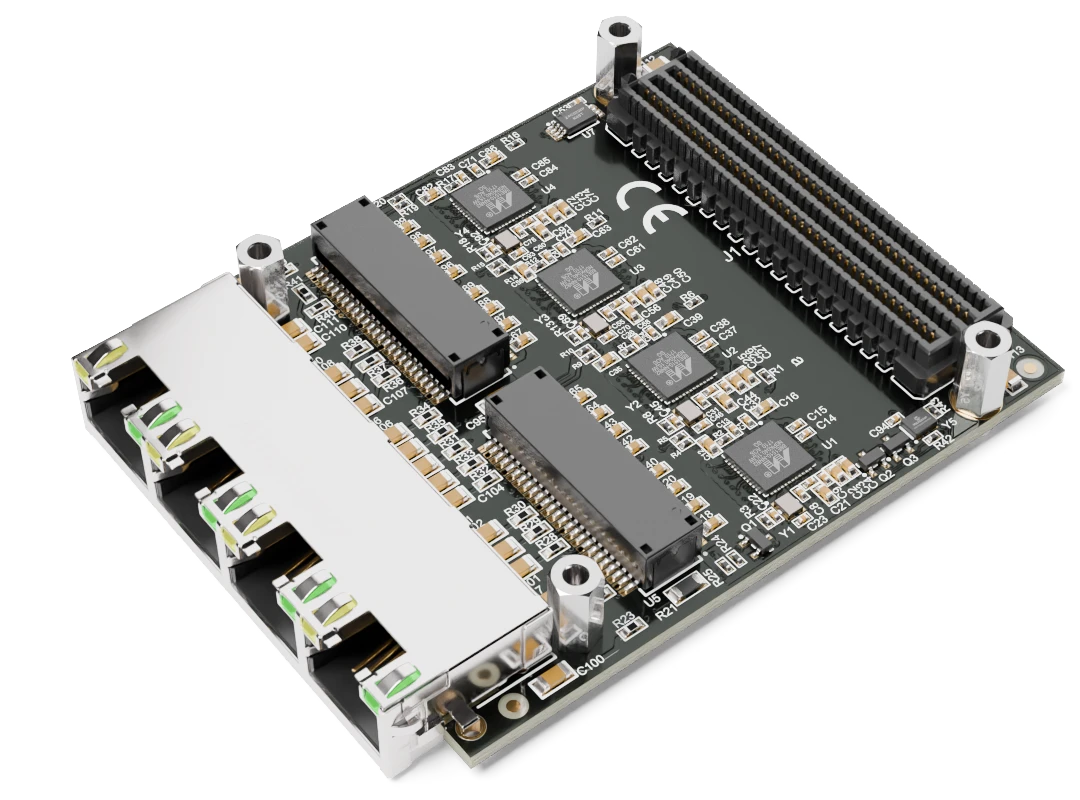
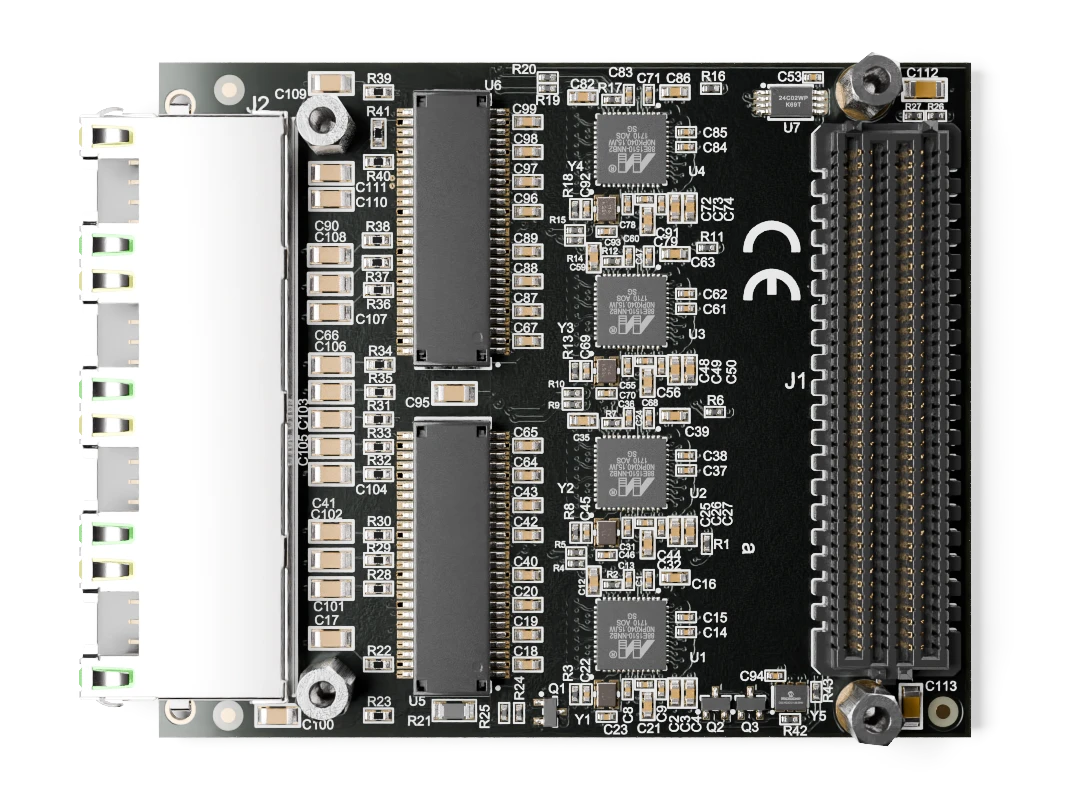
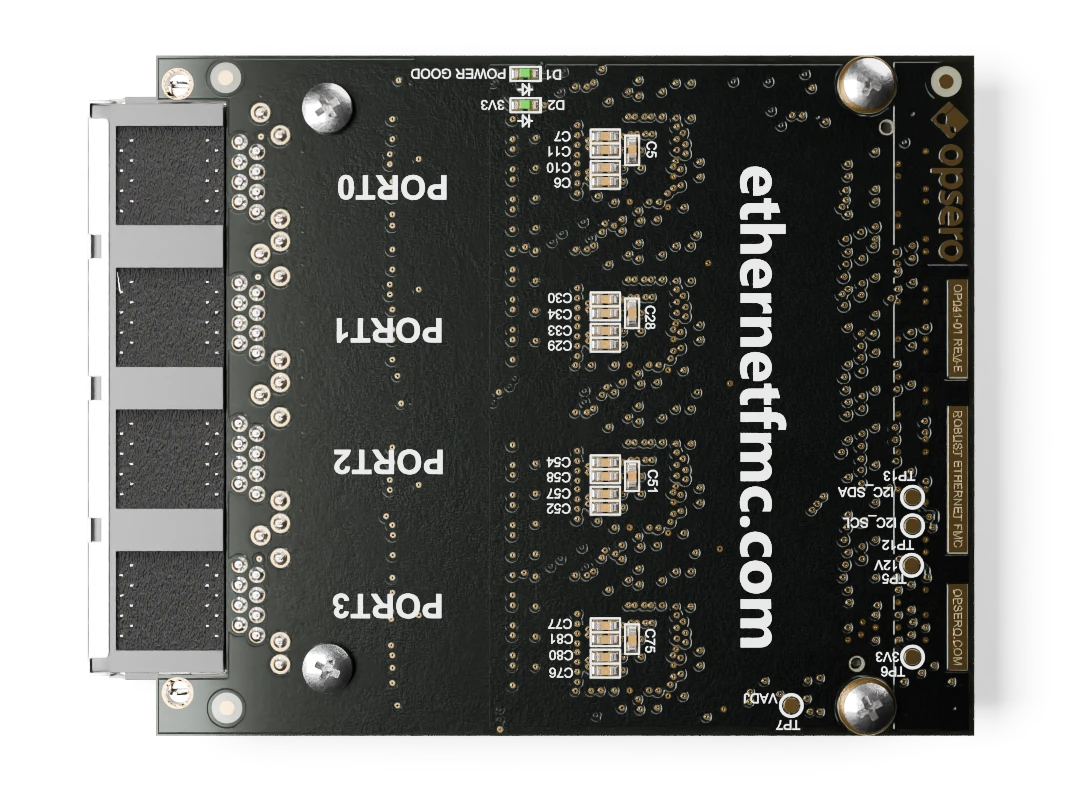
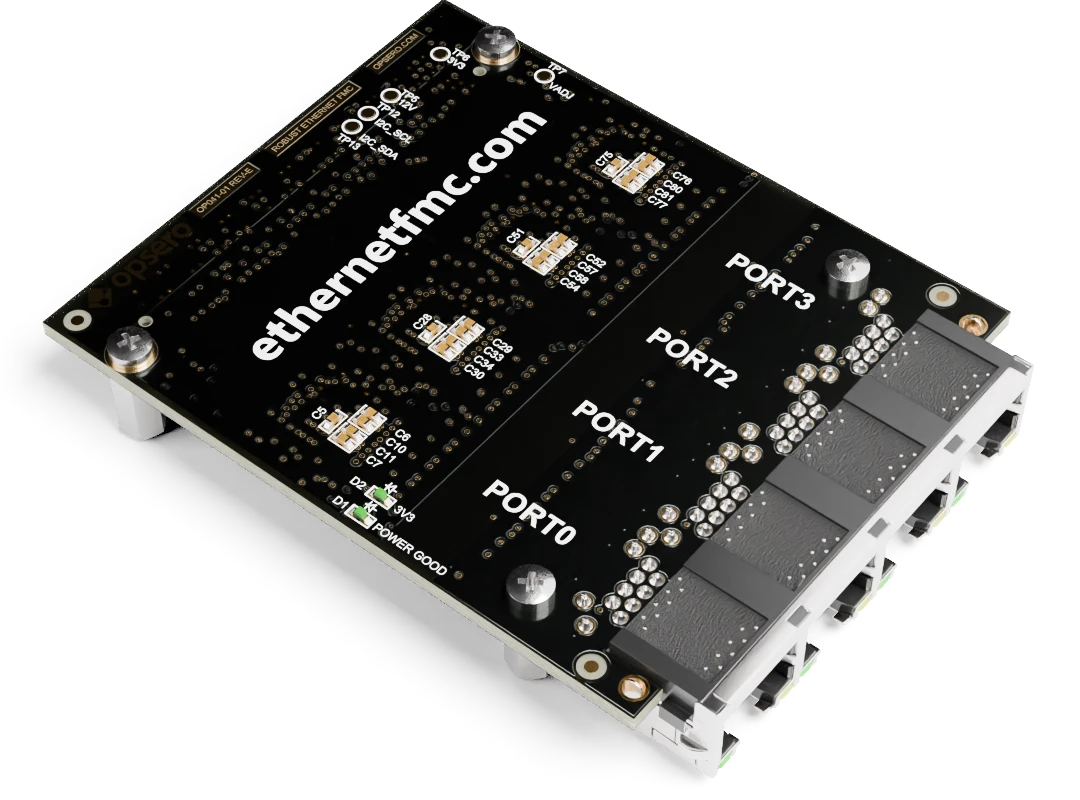
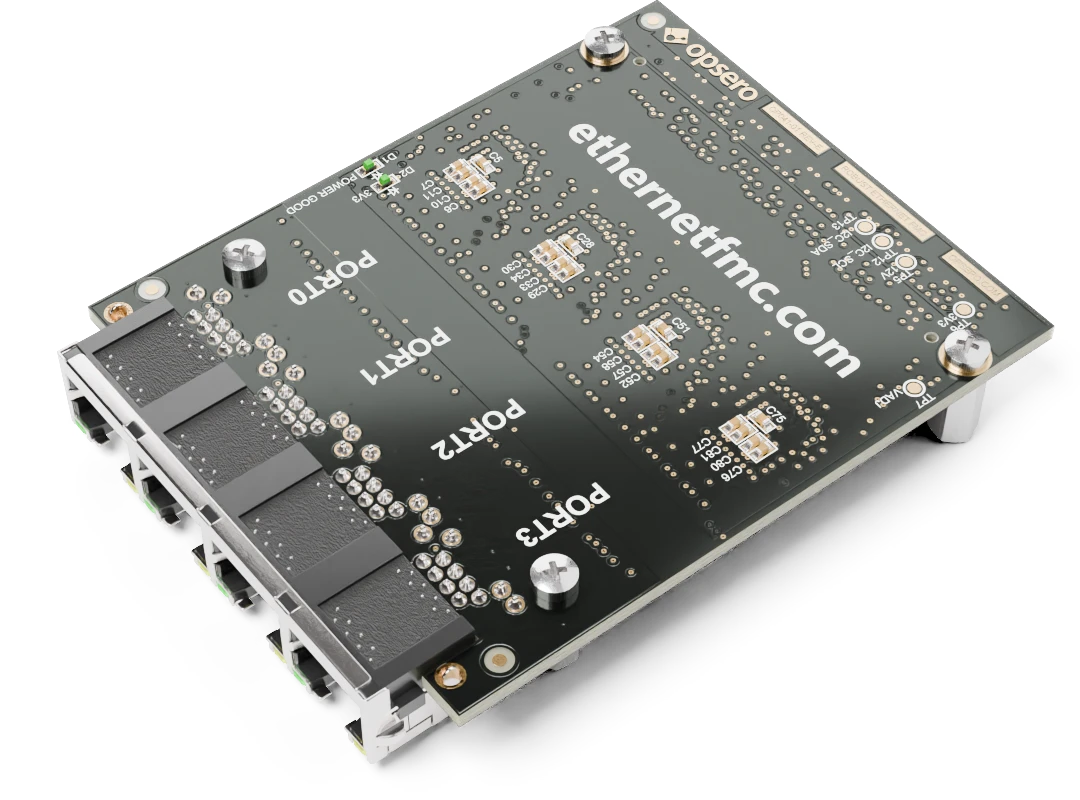
Robust Ethernet FMC 1.8V
Where to buy
| Opsero Direct: (Ships from Canada) |
15 pcs in stock (can ship immediately) |
| Digi-Key: (Ships from USA) | Buy it from Digi-Key |
Description
The Robust Ethernet FMC is an FPGA Mezzanine Card that adds 4x Gigabit Ethernet ports to your FPGA board. It comes with fully working example designs for multiple FPGA boards and the latest version of Vivado. For more detailed information on the Ethernet FMC, including specifications, technical documents and example designs, please read the documentation.
- 4 x 10/100/1000Mbps Ethernet Ports
- LPC FMC: Pin compatible with ZedBoard and other compliant FMC carriers
- 125MHz Oscillator for the MAC
- Reference designs for the ZedBoard and other FPGA development boards
- Straightforward tech support
Intended use and compliance
The Robust Ethernet FMC 1.8V is an FPGA Mezzanine Card, a sub-assembly intended for incorporation into apparatus by professional integrators. It has no standalone function: it operates only when mounted on a compatible FMC carrier and driven by an FPGA design created by the integrator. Opsero has assessed the card's electromagnetic compatibility under the reference conditions described in its EMC integration notes and declares conformity on that basis. The integrator is responsible for the conformity of the apparatus into which the card is incorporated, including its enclosure, cabling, power supply and firmware. This is Class A equipment: in a residential environment it may cause radio interference, in which case the user may be required to take adequate measures.
Declarations and supporting information: Product compliance. EMC integration notes.
Frequently asked questions
Is the Robust Ethernet FMC 1.8V compatible with my FPGA board?
Please visit the product website for a list of compatible FPGA boards. In general, the 1.8V version is required by all Xilinx Ultrascale and Ultrascale+ devices, including the Zynq Ultrascale+. If you’re using any Xilinx Series-7 devices such as the Kintex-7 or the Zynq-7000, please refer to the list of compatible boards.
Which version Ethernet FMC should I use?
The version most appropriate to you will depend on your FPGA board. Please refer to the list of compatible FPGA boards to find the recommended Ethernet FMC for your carrier.
Do I need any purchased IP to use the Ethernet FMC?
No. We provide example designs for the Ethernet FMC that use only free IP, as well as designs that use paid IP, so you can choose the approach that suits your project:
- Taxi Ethernet (free): Uses the open-source 1G RGMII MAC from the Taxi transport library, so no IP license is needed. It supports Zynq UltraScale+ and MicroBlaze based designs. The Taxi library is licensed under the CERN-OHL-S-2.0 (a reciprocal open hardware license) or under a commercial license from FPGA Ninja, so please review its terms before shipping a product built on it.
- PS GEM (free): Uses the hard Gigabit Ethernet MACs (GEMs) in the processing system of Zynq-7000 and Zynq UltraScale+ devices, which don’t require a license.
- AXI Ethernet (paid): Uses the AMD AXI 1G/2.5G Ethernet Subsystem, which is a paid IP core, and has the widest board and processor support (MicroBlaze, Zynq-7000, Zynq UltraScale+ and Versal). You can evaluate it for free with an evaluation license from AMD. See Getting a license for the Xilinx Tri-mode Ethernet MAC for more information.
You are of course free to use the Ethernet FMC with any other MAC of your choice.
What is the maximum effective throughput of the Ethernet FMC?
See performance benchmarks for a complete answer.
Can I use the Ethernet FMC without a processor in my FPGA design?
Yes, you can. See Using the Ethernet FMC without a processor for more information.
Where can I get the datasheet for the Marvell 88E1510 Gigabit Ethernet PHY?
Use this link to download the Marvell 88E151x datasheet.